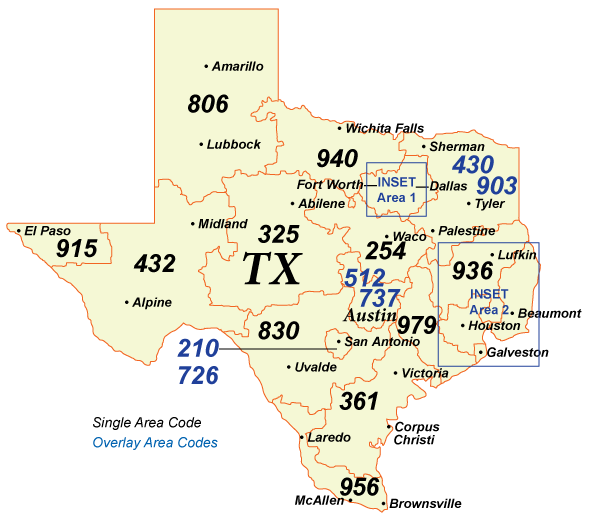
The 409 area code is a telephone area code serving the Beaumont and Galveston areas in Southeast Texas. Look up any phone number starting with 409 area code. Results may include:
The 409 area code is frequently used for Social Security threats and fake process servers. These callers try to scare you with jail time to get your money or personal details immediately.
Scammers using robocalls and live agents, sometimes with strong Indian accents, claim fraudulent activity has been found with your Social Security Number. They threaten that your SSN will be suspended and warn that legal action or arrest is coming if you don't call back immediately to resolve it. The robocalls threaten that "legal action is going to be taken against SSN," claim your SSN was used for "fraudulent activity" and you will be arrested, and demand you call back a specific number to avoid legal consequences. The robocalls never mention you by name. They use your fear to get you to call back and provide personal information or money. The Social Security Administration will never call you to threaten arrest. They show up in your mailbox.
"They said they are with Social Security Administration and said I have been doing fraudulent actions and if I do not want them to pursue legal action that I was to call that number. I can't believe people fall for this crap."
Fake Process Server & Legal Complaint Threat
Callers claim a formal complaint has been filed against you and that you will be "served papers" at your home or place of employment within hours. They ask if you will be available to be served papers, provide a fake case number and a different number to call back, threaten to show up at your "residence or place of employment," and refuse to provide specific details about the alleged complaint. They use your personal information to make the threat seem real and get you to pay money over the phone to stop the fake legal process. Real process servers do not call ahead to warn you. They show up.
"The caller asked if I would be available to be served papers within 2 hours. Said someone had filed a complaint against me. They gave me a different number to call back within 1 hour and a case number. When I asked what this was in regards to they declined to give any details."
Aggressive & Evasive Debt Collection Tactics
Callers identifying as being from agencies like "Phoenix financial" or "SRS" are contacting Southeast Texas residents to collect on very old or non-existent debts. They are very evasive about their name and company, attempt to collect debts that are decades old, send harassing or threatening text messages, and may be trying to reach the previous owner of your phone number. They use your confirmation of any debt information to restart the legal clock on old debts or create fake debts they can sell to other collectors. Under the Fair Debt Collection Practices Act, legitimate collectors must identify themselves and provide written validation if you request it.
"Bottom feeders purchasing our information for pennies on the dollar and then call to collect debts from 20 years ago."
Student Loan Forgiveness "Program" Scam
Scammers are calling about a "Federal Student Loan Forgiveness Program," trying to trick you into thinking they can help you eliminate your debt. They ask for an upfront fee for their services, request your Social Security Number over the phone, hang up when you pressure them for details about their company, and call even if you don't have any student loans. They use your Social Security Number to access your real loan information and steal the upfront fee. Go directly to StudentAid.gov for information about legitimate programs. The U.S. Department of Education never charges fees for forgiveness programs.
"These assholes called about student loan forgiveness program, they were full of shit when I asked them if I had to pay them for their services before I get student loans forgiveness, and she couldn't answer me and they hung up on me..."
Phishing Texts Impersonating Major Companies
Residents are receiving text messages pretending to be from Wells Fargo, AT&T, or the federal government. The unsolicited texts claim your bank card is locked or payment is on hold, promise pandemic relief of "$400 per week for 6 months," contain a link urging you to click it to verify information, and come from standard 10-digit phone numbers, not company short codes. They use the link to steal your login credentials when you enter them on fake websites that look like the real company. Banks and government agencies will not send you text messages with links asking you to verify sensitive information.
"WeIlsFargo-Notice2676:Your card is temporary locked.ln order to unIock, we need to verify some of your information.Call us now at 409-200-7845"
"Linda from Dealer Processing" Vehicle Warranty Scam
Area residents report getting constant robocalls about their car's extended warranty. A recorded voice, sometimes identifying as "Linda from Dealer Processing," starts with a recorded message rather than a live person, offers an "extended warranty" without knowing any details about your car, and calls repeatedly even after you've asked them to stop. They use high-pressure tactics to sell service plans with hidden fees and very limited coverage once you speak with their sales agent. These calls are almost never from your car's actual manufacturer. Pressing a number to be "removed from the list" leads to more calls.
"Same as above. Robo scammer calls constantly "Linda from Dealer Processing" which is an illegal robo call center attempting to get credit card numbers for non-existent warranties."
Recently Reported Area Code 409 Spam Calls
Area Code 409 phone numbers reported as unwanted calls to the FTC in the last 30 days.
(409) 761-7631
9 reports
·
(409) 206-7511
2 reports
·
(409) 948-0451
2 reports
·
(409) 226-7815
2 reports
·
(409) 946-5314
2 reports
·
(409) 203-1554
2 reports
·
(409) 220-1427
2 reports
·
(409) 262-4917
2 reports
·
(409) 262-4110
2 reports
·
(409) 295-2258
2 reports
·
Is area code 409 a scam?
No, 409 is a legitimate Texas area code serving Beaumont, Galveston, and the Southeast Texas Gulf Coast. Scammers spoof it to reach residents who might otherwise ignore an unfamiliar out-of-state prefix.
Why do I get spam calls from area code 409?
Social Security robocalls threatening arrest, accompanied by fake process server calls claiming formal complaints, are the most reported scheme. Phishing texts impersonating Wells Fargo, and aggressive debt collection calls from agencies like Phoenix Financial, are also highly distinctive.
Where Is Area Code 409 Located?
Area code 409 serves the southeastern region of Texas, encompassing the Beaumont and Galveston areas.
Counties Served:
Chambers
Galveston
Hardin
Jasper
Jefferson
Newton
Orange
Polk
Sabine
Trinity
Tyler
Major Cities:
Beaumont
Galveston
Other Cities and Towns:
Anahuac
Bevil Oaks
Bon Wier
Bridge City
Bronson
Brookeland
Buna
Burkeville
Call
China
Colmesneil
Deweyville
Doucette
Evadale
Fannett
Overlay System
Prior to October 2021, area code 409 had telephone numbers assigned for the central office code
988
. This area code transitioned to ten-digit dialing by October 24, 2021.
Area Code 409 Location Map
Area code 409 is a general purpose code which was placed in service on November 1, 1982.