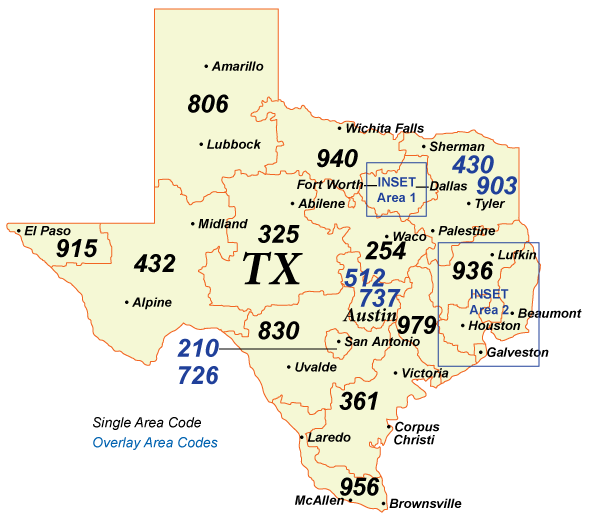
The 361 area code is serving the Corpus Christi area, the Coastal Bend, and the Victoria Crossroads in Texas. Look up any phone number starting with 361 area code. Results may include:
Scammers using the 361 area code frequently use Social Security threats and tech support refund scams. They try to access your bank account by claiming they need to send you a refund or fix a government error.
Residents in the 361 area code are receiving threatening calls from individuals posing as officials from the Social Security Administration. These scammers, sometimes using names like "Officer Steven White" or "Officer Maria," falsely claim your Social Security Number has been compromised or used in criminal activities. The message threatens that your Social Security Number has been suspended or will be permanently blocked, and tells you a legal enforcement action has been filed against you for criminal activities. They demand an immediate call back to avoid legal proceedings. They use your personal information to open accounts and take out loans in your name. The Social Security Administration will never call you to threaten your benefits. They communicate through official U.S. mail.
"My name is Officer Steven White calling you for him to Department of Social Security Administration. The reason you have received this phone call from our department is to inform me about a legal enforcement action, which has been filed on your name and social number for criminal activities."
Tech Support Refund Scam
A caller claiming to be from a tech support company, such as "ProCare Tech Support," states the company is going out of business and offers a refund, often a specific amount like "$299.99," for a service contract you likely never purchased. They ask for your credit card number or bank information to confirm where to send the refund, and the callback number provided is a non-800 number, such as one in the 361 area code. They use your financial information to steal money from your accounts or make unauthorized purchases. Legitimate companies do not call customers to ask for financial information to process a refund.
"someone called pretending to be from a tech support company called ProCare, saying that the company was going out of business and they wanted to refund my $299.00 tech support payment. They said to call back at 361-288-1818."
Aggressive Medical & Prescription Scams
Scammers are targeting South Texas residents with unsolicited calls and texts about medical benefits and prescriptions. Callers may claim to be from well-known insurers like Humana or Blue Cross Blue Shield, offering new PPO plan benefits, but cannot name your specific healthcare provider when questioned. Another common tactic is a text message with an attached image of a "USRX Prescription card." They use your Medicare, insurance, or personal information to file fraudulent claims or steal your medical benefits. Your health insurance provider already has your information and will communicate about benefits through official channels like their secure web portal or U.S. mail.
"I received a text from this number with a RX discount card attached instructing me to use it at my pharmacy. DO NOT USE IT!!! I suspect it will somehow expose your personal information to an identity thief."
Vague "Doctor-to-Doctor" Professional Scam
A caller, often identifying herself as "Shawna," "Deb," or "Nicole," targets local dental and medical offices in the 361 area and asks to speak directly with the doctor. She is evasive about the reason for the call, claiming it's a "proprietary matter" or that the doctor will "know what it's about," and references another doctor's name, like "Dr. Ingber" or "Dr. Dens." She becomes rude or hangs up when questioned by office staff, and threatens to call the doctor's personal cell phone if not put through. They use this access to the doctor to pitch expensive services or equipment the practice doesn't need. Legitimate professional correspondence between doctors is typically handled through established, secure channels or by staff who can clearly state the nature of the business.
"We got a call from Shawna at 361-221-1006 asking to speak with our doctor...she would not leave any details, but said 'he'd know what it was about' and to reference Dr. Ingbre."
Vehicle Warranty Scam
A high volume of robocalls are being made regarding your car's "factory warranty," often creating a false sense of urgency by stating you need to call back immediately to "keep your file open." You receive a robocall about your vehicle's expiring warranty, especially if your car is old or the warranty has long since expired. They cannot provide specific details about your vehicle without you giving them the information first, and the caller gets angry or defensive when you question them. They use the vehicle information you provide to sell you an expensive and often unnecessary extended service plan. Your vehicle's manufacturer will not contact you via unsolicited robocall to sell you an extended warranty.
"The woman called offering to sell me a warranty on my car. I told her this was a scam and she asked why she wasn't in handcuffs then. I hung up and called the number back and there were just chimes ringing and then it disconnected."
Recently Reported Area Code 361 Spam Calls
Area Code 361 phone numbers reported as unwanted calls to the FTC in the last 30 days.
(361) 384-0483
4 reports
·
(361) 202-4424
4 reports
·
(361) 262-7602
4 reports
·
(361) 217-3901
3 reports
·
(361) 348-9095
2 reports
·
(361) 934-6994
2 reports
·
(361) 303-9079
2 reports
·
(361) 587-6940
2 reports
·
(361) 437-0562
2 reports
·
(361) 934-6719
2 reports
·
Is area code 361 a scam?
No, 361 is a legitimate area code covering the South Texas Gulf Coast, including Corpus Christi and Victoria. Callers spoof 361 to appear local to South Texas communities, where a recognizable area code gets answered.
Why do I get spam calls from area code 361?
Social Security Administration impersonators claiming criminal activity is linked to the recipient's SSN are the dominant threat here. Tech support refund scams claiming "ProCare Tech Support" owes you money, and medical benefit phishing texts targeting Medicaid recipients, are also highly active.
Where Is Area Code 361 Located?
Area code 361 covers the Corpus Christi area, the Coastal Bend, and the Victoria Crossroads region of Texas.
Counties Served:
Aransas
Bee
Brooks
Calhoun
DeWitt
Duval
Fayette
Goliad
Jackson
Jim Hogg
Jim Wells
Kenedy
Kleberg
Lavaca
Live Oak
Major Cities:
Corpus Christi
Victoria
Alice
Kingsville
Beeville
Portland
Rockport
Aransas Pass
Port Lavaca
Robstown
Sinton
Ingleside
George West
Refugio
Goliad
Other Cities and Towns:
Agua Dulce
Alfred
Armstrong
Austwell
Banquete
Bayside
Ben Bolt
Benavides
Bentonville
Berclair
Bishop
Blessing
Bloomington
Bruni
Calliham
Overlay System
Prior to October 2021, area code 361 had telephone numbers assigned for the central office code
988
. This area code transitioned to ten-digit dialing by October 24, 2021.
Area Code 361 Location Map
Area code 361 is a general purpose code which was placed in service on February 13, 1999.