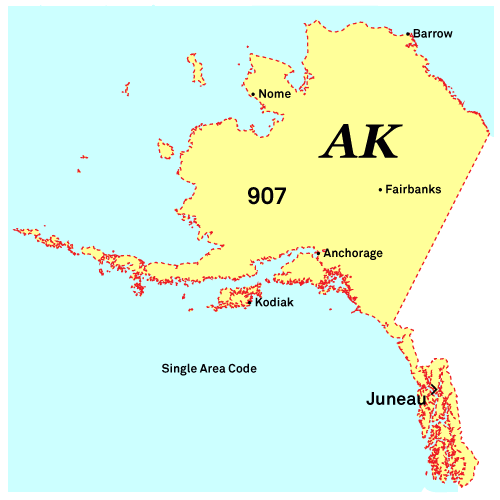
The 907 area code is a telephone area code serving the entire state of Alaska. Look up any phone number starting with 907 area code. Results may include:
Alaska's 907 area code is being used for phony lawsuit threats and fake medical bill collections. Fraudsters claim you owe money for urgent hospital visits to trick you into paying.
Scammers pretending to be debt collectors or process servers call using official-sounding names like "RSI" or "Portfolio Recovery Associates" and threaten you with a "civil suit" or claim you have a case with the "Anchorage borough." They identify themselves as a "process server" over the phone, threaten a "summons" or court date before you've received any official papers, can't name the specific original creditor like the credit card company, and use incorrect local geography such as mentioning a "county court" in Alaska. They use your personal details to make fake court documents and trick you into paying money for debts that don't exist. Real process servers do not call first. They show up.
"Missed call on this one, but a person named LIndsay called about a summons with some county court.....laughed and told her well Alaska doesn't have county courts nor counties and she hung up."
High-Pressure Medical Bill Scam
A caller, sometimes using the name "Eve," claims you have an overdue medical bill that's about to be sent to collections and demands immediate payment over the phone with a debit or credit card. They pressure you for immediate payment on a bill you've never seen before, incorrectly use "HIPAA laws" as an excuse not to provide details, become angry and aggressive when you ask questions or refuse to pay, and the call sounds unprofessional with background noise like children playing. They use your payment information to steal money from your account right away. HIPAA protects your medical privacy, it does not prevent a legitimate billing agent from discussing your own bill with you.
"Bank of America confirmed this is a scam. 'Eve' calls you and says you owe a medical bill and it's going to collections if you don't pay now with debit or credit card. Then says you can dispute it after you've paid because she can't see what the charge is for due to HIPAA laws."
QuickBooks Account "Renewal" Scam
A recorded message from a caller named "Eddie" claims to be from QuickBooks support, stating your annual service renewal is due and the credit card on file "did not go through." You receive an unsolicited call about a payment failure for a subscription service, the message is a generic robocall directed to "accounts payable" not to you by name, and you are instructed to call back a different number than the official QuickBooks support line. They use the callback number to steal your real payment information when you try to "fix" the fake problem. Real companies handle billing through their secure online portal, not through spoofed local numbers and generic robocalls.
"Hi, this is Eddie calling regards to your support for QuickBooks. This message is for accounts payable...the annual service renewal for your QuickBooks account which is in due and the card that which we have on the file it did not go through kindly reaches back to renew the services for your QuickBooks account..."
Suspicious "Survey" Calls
Callers claiming to work for survey companies like "Data Ventures," "Dynata," or "SSI" insist they are not required to honor the Do Not Call list, ask for personal information that has nothing to do with a typical survey like your employer's name, and refuse to leave a name or direct callback number for you to verify them. They gather personal details like your employment status, car ownership, or family information to sell to other marketers or to use for more targeted scams later. Many unsolicited "surveys" are data mining operations in disguise.
"called and asked me to do a survey, asking where me and my family members worked and then hung up on me. strange."
The "Can You Hear Me?" Scam
A robocall dials your number and a recorded voice immediately asks a simple question like, "can you hear me okay?" The very first thing you hear is a recorded voice asking "Can you hear me?", the question seems generic and designed solely to get a "yes" answer, and the call feels unnatural without the typical introduction of a live person. They record your "yes" response and edit it later to make fake audio evidence that you agreed to fraudulent charges or services. A recording of your voice is not a legally binding contract, but scammers play it to banks to force through charges.
"...a recorded message came on and said 'can you hear me okay?' I knew right away that it was the can you hear me scam in which someone will call and try to get me to say 'yes' and then record it..."
Recently Reported Area Code 907 Spam Calls
Area Code 907 phone numbers reported as unwanted calls to the FTC in the last 30 days.
(907) 343-9164
4 reports
·
(907) 891-7975
3 reports
·
(907) 232-2726
3 reports
·
(907) 202-9534
2 reports
·
(907) 215-9901
2 reports
·
(907) 460-1486
2 reports
·
(907) 992-5501
2 reports
·
(907) 202-5993
1 report
·
(907) 202-9243
1 report
·
(907) 202-8896
1 report
·
Is area code 907 a scam?
No, 907 is the official and only area code covering the entire state of Alaska. Con artists leverage this statewide prefix to deceive Alaskans into assuming an incoming call is from a fellow state resident or local agency.
Why do I get spam calls from area code 907?
Fraudsters prey on the isolated nature of Alaskan communities to launch frightening financial shakedowns. Victims routinely report a scammer named "Eve" demanding immediate credit card payments for bogus medical bills while hiding behind fake HIPAA excuses, alongside debt collectors named "Lindsay" threatening nonexistent county court summons in a state that actually uses boroughs.
Where Is Area Code 907 Located?
Area code 907 is a telephone area code in the North American Numbering Plan (NANP) for the U.S. state of Alaska. The Alaska numbering plan area is geographically the largest of any in the United States, and the second-largest in the NANP on the entire North American continent. Due to Alaska's low population, 907 is one of only twelve remaining area codes serving an entire state and is not projected to be exhausted until after 2049. It is worth noting that the small southeastern community of Hyder is not served by area code 907, but by the Canadian overlay complex
236
/
250
/
257
/
672
/
778
from the Stewart, British Columbia rate center.
Counties Served:
Aleutians East Borough
Aleutians West Census Area
Bethel Census Area
Borough of Skagway
Bristol Bay Borough
City and Borough of Anchorage
City and Borough of Juneau
City and Borough of Sitka
City and Borough of Wrangell
City and Borough of Yakutat
Denali Borough
Dillingham Census Area
Fairbanks North Star Borough
Haines Borough
Hoonah-Angoon Census Area
Major Cities:
Anchorage
Bethel
Delta Junction
Eagle River
Fairbanks
Fort Wainwright
Homer
Juneau
Kenai
Ketchikan
Kodiak
Nome
North Pole
Palmer
Prudhoe Bay
Other Cities and Towns:
Adak
Akiachak
Akiak
Akutan
Alakanuk
Allakaket
Ambler
Anaktuvuk Pass
Anchor Point
Angoon
Aniak
Anvik
Arctic Village
Atka
Atqasuk
Area Code 907 Location Map
Area code 907 is a general purpose code which was placed in service on January 1, 1957.