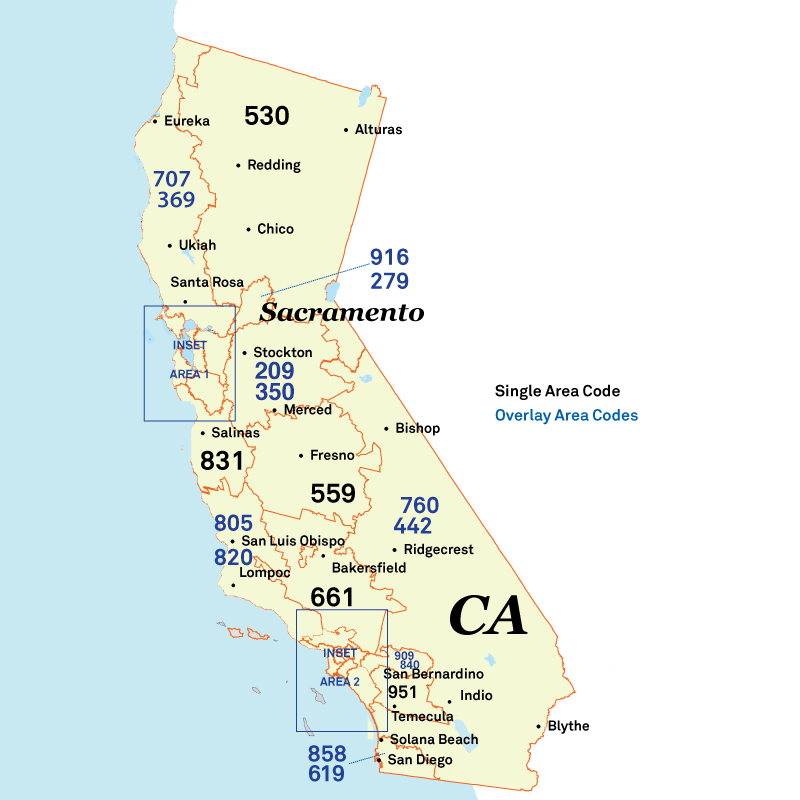
The 657 area code is a telephone area code serving the southern part of California. Look up any phone number starting with 657 area code. Results may include:
The 657 area code is frequently used for threats of arrest and fake package delivery texts. Scammers claim you missed a delivery or have a warrant to trick you into clicking malicious links.
Residents in Orange County receive automated calls claiming "four serious allegations" have been pressed against their name, threatening they will be "taken under custody by the local cops" if they do not call back immediately to discuss the case before legal action is taken. The recording provides only vague references to "serious allegations" without any specific details and creates a false sense of urgency with generic robocall messages rather than live contact from a legitimate agency. They use your callback to fish for personal information and money to supposedly resolve the fake charges. Real officers do not call first. They show up.
"Hours and once it get expired after that you will be taken under custody by the local cops as there are four serious allegations pressed on your name at this moment. We would request you to get back to us so that we can discuss about this case before taking any legal action against you. The number to reach us is 657-230-7516."
Fake Delivery & Package Notifications (Smishing)
You receive text messages claiming to be from USPS, FedEx, or Amazon about a pending package delivery, often mentioning a "Parcel ID" like "SA8643" and urging you to click suspicious links like m3svc.info or mb14j.me to confirm delivery time or "avoid additional fees." The messages come from random 657 numbers instead of official company short codes, and they claim you must confirm to avoid charges even when you weren't expecting any packages. They use the link to steal your personal information and payment details when you try to "confirm" your fake delivery. Official delivery services never send texts from random personal phone numbers asking you to click unofficial links.
"Parcel ID-SA8643 is pending delivery in our warehouse. To avoid additional fees, please confirm delivery time: mb14j.me/qWVIt1mNm5"
Social Security Number Fraud Alert
Scammers use robocalls claiming "legal enforcement actions" have been filed against your Social Security number due to fraudulent activities, with callers identifying as being from the "SSI office" and demanding immediate callback to specific 657 numbers like 657-667-1562 "at the earliest possible" moment before they "begin with the legal proceedings." They use your callback to extract your Social Security number and personal information to commit identity theft. The Social Security Administration never calls people to warn them of legal action. They communicate through official mail only.
"There is a legal enforcement actions filed on your Social Security number for fraudulent activities so when you get this message kindly call back at the earliest possible on our number before we begin with the legal proceedings that is 657-667-1562 thank you…"
Student Loan Forgiveness "Final Notice"
Repeated calls and voicemails come from "Cynthia" at "Student Enrollment Services" about a "final attempt" to reach you for a student loan forgiveness program, claiming you have until a specific day like Friday to respond and mentioning eligibility for a "Federal Assistance Program" for student loans. When you call back, it goes to a message saying all representatives are "busy," and they continue calling for weeks with the same "final notice" message. They use your callback to sell you fake loan forgiveness services or steal your federal student aid login information. Real federal loan servicers communicate through official website portals and U.S. mail. They never use high-pressure robocalls with fake names and deadlines.
"Blocked caller id so I didn't answer. Voicemail from 657-229-0172 appears. It's Cynthia saying this this the third and final attempt to contact me about some student loan forgiveness program."
Fake Tech Support Invoice
Scammers cold-call residents, often at 6:39 AM, claiming you owe $299 for computer work done two years ago and insisting you must pay immediately to cancel the charge. The callers have heavy accents, cannot provide details about the alleged service, become defensive when questioned about what kind of computer you own, and quickly hang up when challenged. They use your payment information to steal money for nonexistent computer services. A real company would have detailed invoices, dates, and specifics about your device. These are cold-call tactics designed to scare you into paying for nothing.
"I called this number, as I was left a 'voice message' saying that I owed $299 for the work done on my computer 2yrs ago... I called and got someone with a very heavy 'accent' that said I had them work on my computer and wanted their money. I told them I never had any work needed on my computer and asked the person WHAT kind of computer do I have....and he hung up!!!"
Vehicle Service Contract Expiration Robocall
You receive robocalls from "Mark" with an "important message about your automobile service contract," falsely claiming your service contract has expired or is about to expire and pressuring you to "press eight" to speak with an agent to extend coverage or "press the number 9" if declining coverage. They use your keypress responses to confirm your line is active and sell you overpriced or unnecessary warranties. Your vehicle manufacturer or dealership already has your contract information and contacts you via official mail with proper documentation. They never use generic robocalls from random numbers.
"hi this is Mark with an important message about your automobile service contract seems like the time to renew or extend your service contract has expired or will be expiring shortly if you would like to keep coverage or extend it press eight to speak to a customer service agent..."
AT&T Overcharge Refund Text Scam
Scammers send text messages pretending to be from AT&T, often using your first name, falsely claiming AT&T "accidentally overcharged your account last month" and providing suspicious links like k6hpw.info or m5cwu.info for you to claim your "compensation." The messages come from regular phone numbers instead of official AT&T short codes and may use your name even if you are not the primary account holder. They use the phishing link to steal your account login and personal information when you try to claim the fake refund. AT&T handles billing credits directly on your account. They never send texts with unofficial links requiring personal information entry.
"AT&T Free Msg: My Name, we accidentally overcharged your account last month. Kindly your compensation here: k6hpw.info/oq7ACrEmsm"
Recently Reported Area Code 657 Spam Calls
Area Code 657 phone numbers reported as unwanted calls to the FTC in the last 30 days.
(657) 279-1319
5 reports
·
(657) 644-7671
3 reports
·
(657) 667-1257
3 reports
·
(657) 331-5674
3 reports
·
(657) 842-3544
2 reports
·
(657) 221-3882
2 reports
·
(657) 689-1929
2 reports
·
(657) 500-2484
2 reports
·
(657) 695-1202
2 reports
·
(657) 571-4795
2 reports
·
Is area code 657 a scam?
No, 657 is a valid area code serving northern Orange County, California, as an overlay to the 714 prefix for cities like Anaheim, Santa Ana, and Huntington Beach. Criminals spoof this code because an Orange County number carries a sense of local legitimacy that can trick unsuspecting residents into answering suspicious inquiries.
Why do I get spam calls from area code 657?
Orange County residents are frequently targeted by legal intimidation scams where robocalls claim "four serious allegations" have been filed and local police are en route for an arrest. Another common tactic involves delivery smishing texts that use the 657 prefix to send fake USPS "Parcel ID" notifications containing malicious links like m3svc.info. These campaigns often use a false sense of urgency, claiming you must pay a small fee to release a package held at a local warehouse.
Where Is Area Code 657 Located?
Phone numbers with the 657 area code originate from northern and western Orange County, a portion of Los Angeles County, and specific areas within San Bernardino County. While primarily serving these regions, some areas, such as portions of La Habra, and all of Seal Beach, Los Alamitos, the far northwestern portion of Brea, and the western portions of La Palma, are served by other area codes like 562. Additionally, cities like Costa Mesa, Irvine, Santa Ana, Tustin, and Newport Beach straddle the 657/714 and 949 area codes.
Counties Served:
Los Angeles County, California
Orange County, California
San Bernardino County, California
Major Cities:
Anaheim
Buena Park
Costa Mesa
Cypress
Fountain Valley
Fullerton
Garden Grove
Huntington Beach
Orange
Placentia
Santa Ana
Tustin
Villa Park
Yorba Linda
Other Cities and Towns:
Brea
Cerritos
Chino Hills
Irvine
La Habra
La Mirada
La Palma
Los Alamitos
Midway City
Modjeska Canyon
Newport Beach
North Tustin
Orange Park Acres
Santiago Canyon
Seal Beach
Overlay System
Area code 657 was introduced as an overlay onto the existing
714
area code territory. Area code 714 was originally assigned in 1951. Due to the increasing demand for telephone numbers, area code 657 was overlaid onto the 714 territory on September 23, 2008. This means that area codes 657 and 714 now serve the same geographic region.
Area Code 657 Location Map
Area code 657 is a general purpose code which was placed in service on September 23, 2008.
Prefixes by Rate Center
Rate Center
Number of Prefixes
SANTA ANA
13
ANAHEIM
9
ORANGE
6
HUNTITNBCH
5
GARDEN GRV
4
WESTMINSTR
4
PLACENTIA
3
CYPRESS
2
FULLERTON
2
BUENA PARK
1
YORBALINDA
1
Other California Area Codes
Browse California area codes for phone number lookup: