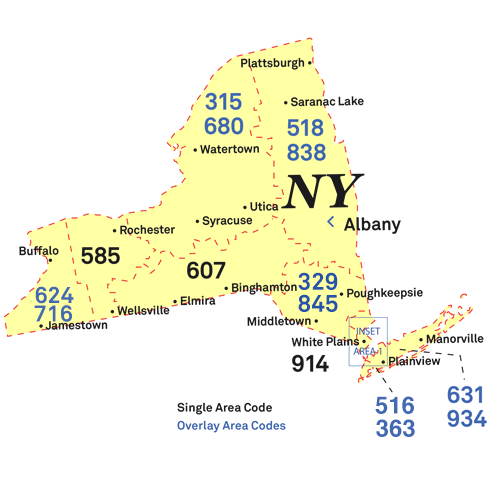
The 347 area code is serving the New York City boroughs of the Bronx, Brooklyn, Queens, and Staten Island, as well as the Marble Hill section of Manhattan. Look up any phone number starting with 347 area code. Results may include:
The 347 area code is known for Social Security threats and fake debt collection hoaxes. Scammers pose as government officials or lawyers to intimidate you into settling non-existent debts.
Callers identifying as "Officer Steven White," "Kevin Williams," "Kevin Jones," or "Allen White" claim your Social Security number has been blacklisted due to fraudulent activity and threaten that an arrest warrant has been issued with police being sent to your place of employment "tomorrow morning" unless you return the call immediately. They use your fear of arrest to trick you into providing personal information or money to resolve the fake legal issue. The Social Security Administration does not suspend or blacklist numbers. Real warrants are served in person by officers who do not call ahead to warn you.
"This morning I received a phone call... Informing me that if I didn't return the call my Social Security Number would be Blacklisted and tomorrow morning I would be arrested at my place of employment."
The "Garden Law Firm" Debt Collection Hoax
Scammers claiming to be from "Garden Law Firm," "Addison and Ashford," or representing "CashNet USA" harass users about non-existent payday loans or "3 allegations" of fraud, often citing specific fake debt amounts like $7,000+, and threaten to garnish paychecks or serve papers at your workplace without providing any written notice. They use your fear of wage garnishment to pressure you into paying debts you do not owe. Legitimate debt collectors must provide written validation within five days of contact and cannot garnish wages without a prior court judgment.
"Received 6 phone calls from two males named mark, both foreign and one from garden law. Said... there was a civil suit against me... contacting my place of employment to garnish my paychecks."
"Grandson in Jail" Emergency Scam
Callers identifying as attorney "Peter Green" or "Mark Stevens" target seniors claiming a grandson has been in a car accident involving a pregnant woman or arrested for DUI and demand thousands of dollars in cash or wire transfer to be sent immediately to avoid legal consequences. They use your love for family and fear of legal trouble to steal your money through untraceable payment methods. Bail is paid to the court, not to attorneys via cash courier or wire transfer. Real attorneys and police officers never call family members demanding immediate cash payments.
"Called 90 year old pretending to be Peter Green from the county. Said grandson was in an accident and needed bail money. Said it had to be cash."
AT&T "Signal Issues" & Reimbursement Texts
Users in the 347 area receive text messages claiming to be from AT&T apologizing for "signal issues on September 12" or similar dates, promising a "symbolic reimbursement" or "little gift" and including suspicious links to non-AT&T domains like `6kgop.com` or `s6ewz.info`. They use the link to install malware on your phone or steal your login credentials when you enter them on the fake website. Mobile carriers apply credits directly to your bill statement. They do not send text messages asking you to click external links to claim refunds.
"AT&T Free Msg: Sorry for the signal issues on September 12, here's a symbolic reimbursement --- they provided a link which is obviously spam."
Publishers Clearing House Prize Scam
Scammers posing as "David King," "Michael Washington," or "Dave Sawyer" claim you have won millions (often $2.5 or $5.5 million) and a Mercedes Benz, insisting the prize team is on the way with a flatbed truck but requiring you to pay an "FDIC insurance fee" or buy gift cards before delivery. They steal your upfront payment and disappear without delivering any prize. If you have to pay to get it, it is not a prize, it is a scam.
"Scammer... claiming to be from Publishers Clearing House. Promising money and new Mercedes Benz to be delivered to home address on flatbed truck! Wanted money sent by money order..."
Cable Provider "Software Update" Fraud
Fraudsters impersonating Optimum, Spectrum, or DirectTV using names like "Sylvester Alex" or "Mark Clement" claim to be "Tech Supervisors" saying your receiver needs a software update or satellite alignment, demanding payment of roughly $199 or $299 for "hold security" to prevent service interruption, sometimes promising a discount on future bills as compensation. They steal your credit card information and charge unauthorized fees to your account. Cable and satellite providers push software updates automatically and remotely at no cost. They do not call customers to demand payment for maintenance.
"Caller claims to be ATT/ Direct TV / Tech Supervisor for Software update of receivers for satellite alignment... $40 discount on monthly bill for 2 yrs after $299.00 Hold Security received..."
Fake Job Recruitment & Certification Scams
Scammers posing as recruiters from "Bright Allies Company Limited" or referencing "Blaze Staffing Solutions" offer fake positions like Verizon Project Manager roles, conducting interviews via text or chat with poor grammar, then demanding you pay out-of-pocket for specific training like "Scrum Master Certification" through bogus portals like ExpertsLearn.com. They collect your training fees and disappear without providing any real job or certification. Legitimate employers do not ask candidates to pay for their own certification upfront. Real companies do not conduct high-level interviews exclusively via text message.
"I was told the contract was with their client Verizon, and I needed to be a Certified Scrum Master... sponsor half if I went through some training company called ExpertsLearn.com."
Recently Reported Area Code 347 Spam Calls
Area Code 347 phone numbers reported as unwanted calls to the FTC in the last 30 days.
(347) 588-1390
5 reports
·
(347) 596-4074
5 reports
·
(347) 973-8252
3 reports
·
(347) 309-7617
2 reports
·
(347) 974-7500
2 reports
·
(347) 914-4311
2 reports
·
(347) 395-2302
2 reports
·
(347) 704-6517
2 reports
·
(347) 914-2838
2 reports
·
(347) 407-7522
2 reports
·
Is area code 347 a scam?
No, 347 is a legitimate New York City area code serving the outer boroughs, including Brooklyn, Queens, and the Bronx. Scammers spoof it because a New York City number carries immediate local credibility across the entire metropolitan area.
Why do I get spam calls from area code 347?
Social Security blacklist threats from fake officers promising police will arrive at your employer are heavily reported. Publishers Clearing House prize scams demanding FDIC insurance fees, and grandparent bail-money scams involving fake attorneys demanding cash-only payments, are highly destructive local patterns.
Where Is Area Code 347 Located?
Area code 347 covers the boroughs of the Bronx, Brooklyn, Queens, and Staten Island in New York City, as well as the Marble Hill section of Manhattan.
Counties Served:
Bronx
Kings (Brooklyn)
Queens
Richmond (Staten Island)
New York (Manhattan) - Marble Hill section only
Major Cities:
The Bronx
Brooklyn
Queens
Staten Island
Other Cities and Towns:
Marble Hill
Overlay System
Area code 347 is part of an overlay complex with area codes
718
and
929
, which cover the same geographic region. Area code 347 became effective on October 1, 1999. Mandatory ten-digit dialing was required for the 718/347 numbering plan area by April 15, 2000. Additionally, area code
917
overlays area codes 718, 347, and 929, as well as area codes
212
,
646
, and
332
in Manhattan. Area code
465
is scheduled to overlay the numbering plan area on June 18, 2026.
Area Code 347 Location Map
Area code 347 is a general purpose code which was placed in service on October 1, 1999.
Prefixes by Rate Center
Rate Center
Number of Prefixes
NWYRCYZN06
181
NWYRCYZN07
95
NWYRCYZN03
93
NWYRCYZN08
77
NWYRCYZN04
61
NWYRCYZN05
61
NWYRCYZN10
53
NWYRCYZN14
31
NWYRCYZN09
26
NWYRCYZN12
25
NWYRCYZN11
21
NWYRCYZN13
20
NWYRCYZN15
20
Other New York Area Codes
Browse New York area codes for phone number lookup: