Phone Number Lookup by North Carolina Area Code
Charlotte operates 704/980, Raleigh has 919/984, Greensboro uses 336, the coast runs 252. The table below maps all North Carolina codes to cities. Overlays in major metros mean streets share multiple codes.
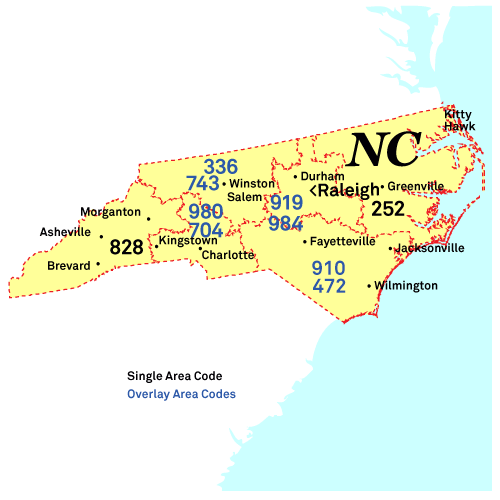
- 252 Phone Number Lookup: Greenville, Rocky Mount, Wilson
- 336 Phone Number Lookup: Greensboro, Winston-Salem, High Point
- 472 Phone Number Lookup: Fayetteville, Wilmington, Jacksonville
- 704 Phone Number Lookup: Charlotte, Concord, Gastonia
- 743 Phone Number Lookup: Greensboro, Winston-Salem, High Point
- 828 Phone Number Lookup: Asheville, Hickory, Lenoir
- 910 Phone Number Lookup: Fayetteville, Wilmington, Jacksonville
- 919 Phone Number Lookup: Raleigh, Durham, Cary
- 980 Phone Number Lookup: Charlotte, Concord, Gastonia
- 984 Phone Number Lookup: Raleigh, Durham, Cary
North Carolina has approximately 14.1 million active phone numbers. Cell phones are the dominant type with 11.8 million users, while traditional landlines are declining with 534,000 connections statewide. Internet phone services account for about 1.8 million numbers.
North Carolina Phone Numbers Reported to the FTC
In September 2026, North Carolina residents filed 7,606 complaints to the FTC about phone numbers making unwanted calls and text messages, up 2% from the previous month.
North Carolina phone numbers recently reported for making unwanted sales calls or robocalls:
| Phone Number | FTC Complaints | Last Reported |
|---|---|---|
| (252) 315-3680 | ||
| (919) 601-5184 | ||
| (984) 231-5384 | ||
| (704) 665-0118 | ||
| (980) 262-5316 | ||
| (984) 231-5385 | ||
| (984) 375-6243 | ||
| (336) 252-5903 | ||
| (919) 666-6569 | ||
| (704) 551-6630 |
Look Up All Numbers to Avoid Common Phone Scams in North Carolina
- Duke Energy & Duke Health Impersonators: Scammers spoofing utility and hospital numbers to sell third-party water line protection, security systems, or demand dates of birth for 'billing'.
- 'Jim Gomez' Ricoh/Toshiba Toner Scam: B2B scammers asking for printer model numbers (e.g., HP2055) under the guise of sending free manuals, then shipping wildly overpriced toner.
- 'Rhonda' Dealership Car Giveaway: Fake prize calls claiming you won a car from a promotional form filled out 12-18 months ago, requesting immediate callbacks to an extension.
- NC Troopers Association / Firefighter Supporter Line: PACs or fraudulent charities using disingenuous scripts and refusing to provide Tax ID numbers to solicit credit card donations.
- North Carolina Consumer Protection Hotline: (877) 566-7226
Browse North Carolina Phone Directories by City
Look up phone numbers and browse the phone directory for the largest cities in North Carolina.
- Charlotte Phone Lookup & Directory
- Raleigh Phone Lookup & Directory
- Greensboro Phone Lookup & Directory
- Durham Phone Lookup & Directory
- Winston Salem Phone Lookup & Directory
- Fayetteville Phone Lookup & Directory
- Cary Phone Lookup & Directory
- Wilmington Phone Lookup & Directory
- High Point Phone Lookup & Directory
- Concord Phone Lookup & Directory
Official North Carolina Government Phone Directories
If a caller claims to be from a government office in North Carolina, or you need an official number, these government directories let you check it at the source.
State of North Carolina Directory and Hotlines
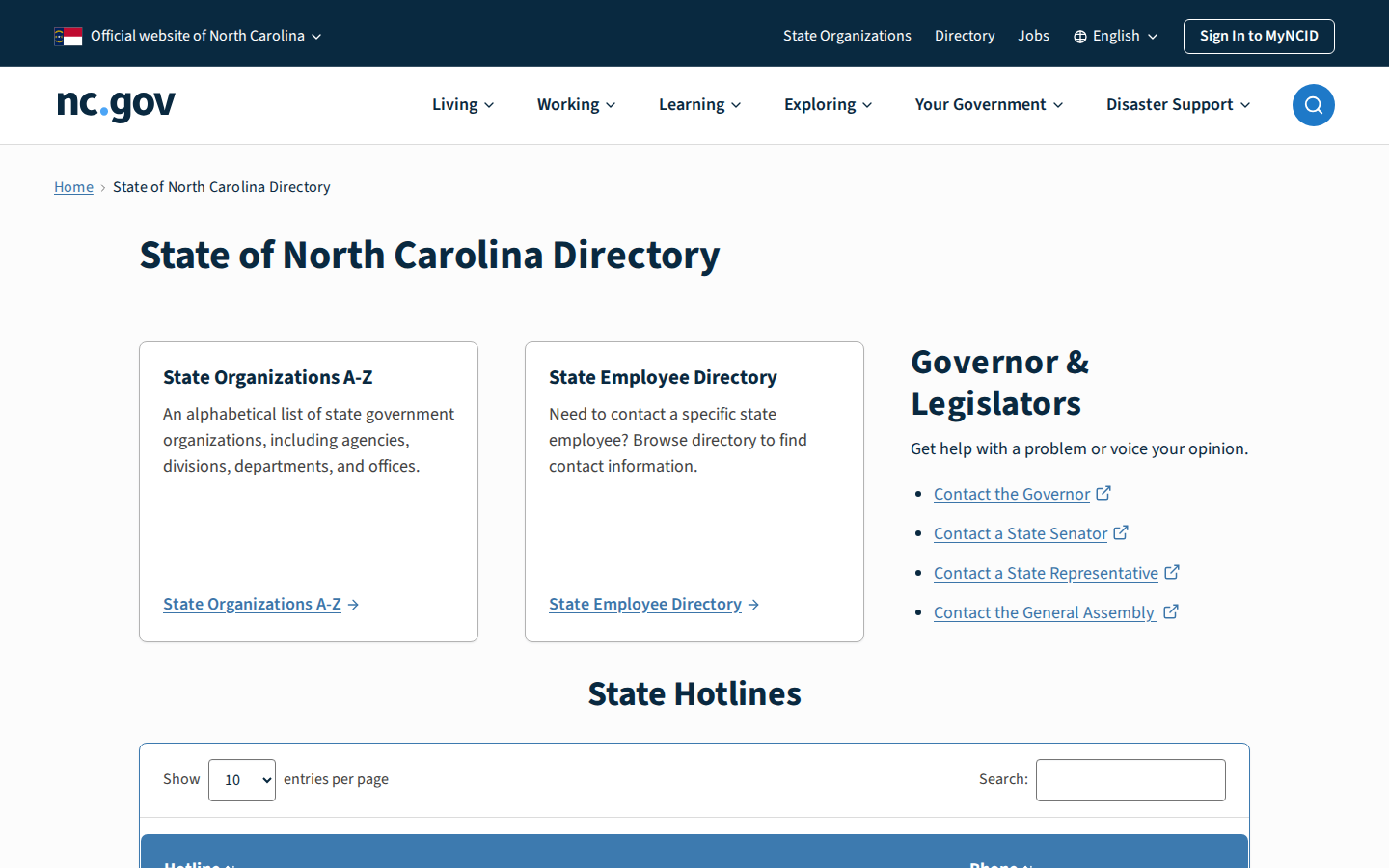
The NC.gov State of North Carolina Directory is a hub. It links to the A to Z list of state organizations, the State Employee Directory and the contact pages for the Governor and legislators.
Below the links, a State Hotlines table lists toll-free numbers, including the Governor's Information and Referral Line at 800-662-7952, the DHHS Customer Service Center at 800-662-7030, the Crime Victims Hotline at 800-826-6200 and traffic information at 511.
North Carolina State Organizations A to Z
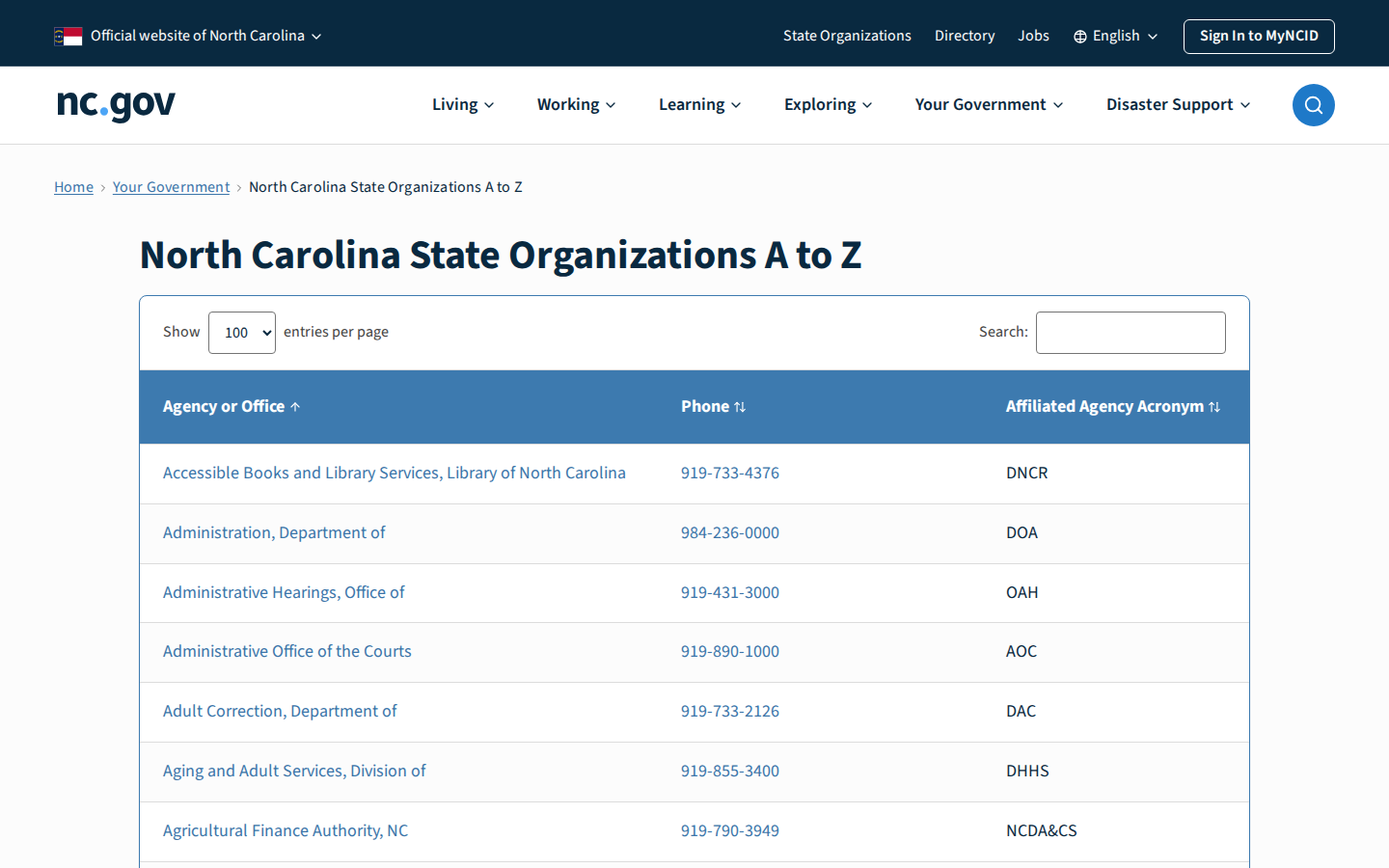
NC.gov's State Organizations A to Z list is a sortable table of North Carolina state agencies and offices. Use the search box to filter it, show 10 to all rows per page, and sort by agency name, phone or acronym.
Each row gives the organization's name (linked to its website), a tap-to-call phone number and the acronym of its parent agency. The Governor's Office is at 919-814-2000 and the Department of Justice at 919-716-6400. Some entries have no phone number.
Is Reverse Phone Lookup Legal in North Carolina?
Yes. North Carolina has no comprehensive consumer data privacy law, though the state is actively considering legislation as of 2025. Unlike neighboring Virginia (VCDPA, effective January 1, 2023) and Tennessee (TIPA, effective July 1, 2025), residents currently have no state-level privacy rights for lookup services. Federal FCRA rules apply in North Carolina as in all states: lookup results may not legally be used for employment screening, tenant decisions, or credit and insurance underwriting.
FAQs About Phone Number Search in North Carolina
How do I remove my number from reverse phone directories in North Carolina?
North Carolina doesn't have a privacy law, but you can still get your info removed from reverse phone directories. Go to each site's privacy settings and submit an opt-out or removal request.
How to verify a North Carolina phone number belongs to a real business?
Phone numbers can be spoofed to appear as though they belong to legitimate companies. Although North Carolina has over 254,636 business establishments reported by the U.S. Census, you should verify the business name by searching the North Carolina Business Search.
What kind of phone numbers does North Carolina use?
North Carolina has 11.8 million mobile subscriptions, 1.8 million VoIP numbers, and 534,000 landlines.
- US Phone Number Lookup
- / North Carolina