The 720 area code serves the north-central portion of Colorado, including Denver and Boulder, as well as their surrounding suburbs. Look up any phone number starting with 720 area code. Results may include:
The 720 area code is being used for fake legal threats and sheriff jury duty scams. Fraudsters claim you have a warrant for missing jury duty and must pay a fine to avoid arrest.
Robocallers claim you have a "civil complaint" or "faxed complaint" filed against you and threaten to serve papers at your home or workplace. They say the voicemail itself has "officially notified" you and pressure you to call a different number to resolve the "pending matter." They use fake case numbers to make the threat seem real. When you call back, they collect your personal information or demand payment to make the problem disappear. Real process servers deliver documents in person without calling first.
"Voicemail saying they've received a fax with a civil complaint against me and threatened to show up at my home or place of employment."
Sheriff's Department Jury Duty Warrant Scam
Live callers impersonate deputies from Arapahoe or Boulder County Sheriff's offices, sometimes using real names like "Deputy Osborne." They claim you have warrants for missing jury duty and demand immediate payment of $1,000 via cash card or MoneyPak to avoid arrest. They know your full name and address to sound legitimate. They use your payment information to steal money or commit identity theft. Sheriff's offices never call to demand phone payments for warrants. Warrants are handled through official court systems.
"Got a call from the number of the Boulder County Sheriff's office and a man claiming to be a deputy officer... He knew my full name and home address and told me to call back on his extension... and claimed I had 2 warrants out for my arrest for missing jury duty... He wanted me to get a cash card with $1000 to pay my bond."
Social Security Administration (SSA) Scam
Robocalls and live callers claiming to be from Social Security, sometimes naming themselves "Audrey" or "Tracy," say your Social Security Number has been compromised or used in illegal activity. They threaten to suspend or cancel your SSN and demand you press 1 to speak to an agent or call back immediately to avoid legal action. They use your personal information to open accounts, file fake tax returns, or steal benefits. Social Security communicates through official mail, not threatening phone calls.
"I returned the call I was told my social security number has been compromised and involved in illegal activity. They asked if I knew of any activity like this with my SSN and I said no. They began to tell me how they can help. Scam."
IRS & Fake Tax Lien Scam
Callers claiming to be from the IRS or tax resolution firms like "The Phoenix Group" use names such as "Jimmy Walters" or "Nate Clark." They claim you have a tax lien or issue with a "941 assessment" and say this is their "final attempt" to reach you before legal action. They mention "federal withholding tax matters" and create urgency to get you to call back. They use your business or personal information to file fraudulent returns or steal refunds. The IRS contacts taxpayers first through official U.S. Mail, not threatening voicemails.
"Jimmy called to say it was a Federal withholding matter and it was his final attempt to reach me and left a number."
Utility Shut-Off Impersonation (Xcel Energy)
Scammers claim to be from Xcel Energy and say your account is delinquent and your power will be shut off within 30 minutes unless you make immediate payment, often demanding cash or untraceable payment methods. They use your payment information to steal money or access your bank accounts. Xcel Energy provides multiple written notices before shutting off service and never demands immediate phone payments with 30-minute deadlines.
"Claims to be Xcel Energy saying the power will be shut off today at this address. Contacted Xcel directly and they say all is good with our account."
Fake Delivery "Failure to Comply" Scam
A caller named "Amanda" from a mumbled company name like "EMI" claims a "delivery agent" came to your property to get documents signed and threatens consequences for "failure to comply" if you don't call back. They provide a callback number different from the one they called from and mention returning your file for non-compliance. This is a phantom debt collection tactic designed to get you to call back and provide personal or financial information. No delivery agent exists and there are no real documents.
"Hello this is Amanda calling from EMI I have had a delivery agent out there again to the property address on file he was defintely getting somebody to sign the documents today our Contact is 720-419-2470 we will only be ale to make one more time before we return as failure to comply"
Vehicle Extended Warranty Robocalls
Automated messages warn about your car's extended warranty expiring and urge you to press a button to speak with a "warranty specialist." They call repeatedly from different 720 numbers, sometimes 3-4 times daily, and may reference cars you no longer own or never owned. Pressing buttons to be "removed from the list" leads to more calls. They sell overpriced service contracts with limited coverage and many exclusions to high-pressure third-party sellers. These are not calls from your car's manufacturer or dealership.
"I get SO many calls from this company about the warranty on my car! I've told them to stop calling. Asked them to stop calling. Told them I don't need the warranty/don't want it, etc. etc. They don't listen. I block one number and they call from another number."
Fake Amazon Purchase Confirmation
Robocalls claiming to be from Amazon security or billing alert you to a suspicious charge, often $349.99, on your Visa card and instruct you to call a specific 720 number immediately if you didn't make the purchase. When you call, they collect your account login credentials, credit card information, or personal details to access your real Amazon account or steal your identity. Amazon never calls to confirm purchases and sends all account notifications through their secure website, app, or official email.
"Got a call claiming to be from Amazon.com wanting confirmation of a VISA purchase for the amount of $349.99. Said if I did not make that purchase call the number 720-398-5112."
Recently Reported Area Code 720 Spam Calls
Area Code 720 phone numbers reported as unwanted calls to the FTC in the last 30 days.
(720) 456-3746
5 reports
·
(720) 704-5971
4 reports
·
(720) 848-5146
4 reports
·
(720) 355-6176
3 reports
·
(720) 899-5931
3 reports
·
(720) 682-0217
3 reports
·
(720) 914-4504
3 reports
·
(720) 208-0293
2 reports
·
(720) 824-9573
2 reports
·
(720) 206-2141
2 reports
·
Is area code 720 a scam?
No, 720 is a standard area code serving the greater Denver metropolitan area as an overlay to 303. Fraudsters constantly spoof these digits to masquerade as local businesses or government agencies operating within the state capital region.
Why do I get spam calls from area code 720?
The Denver metro region is flooded with utility impersonators and fake law enforcement extortion attempts. Callers frequently impersonate Xcel Energy to demand untraceable cash payments for fake delinquent accounts, and pose as Boulder County Sheriff's deputies demanding $1,000 MoneyPak cards for missed jury duty.
Where Is Area Code 720 Located?
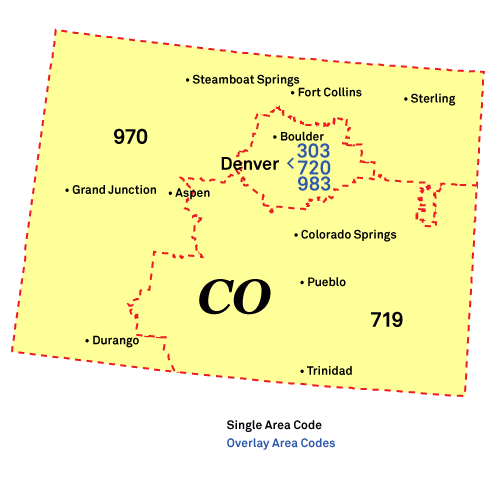
Area code 720 covers the same geographic area as area code 303. This includes Denver, Boulder, and their surrounding suburbs in north-central Colorado.
Major Cities:
Denver
Boulder
Lakewood
Littleton
Longmont
Broomfield
Aurora
Castle Rock
Other Cities and Towns:
Brighton
Roggen
Wiggins
Overlay System
Area code 720 is part of an overlay complex with area codes
303
and
983
, meaning they serve the same geographic region. Area code 303 was the original area code, established in 1947. Area code 720 was added in 1998, and area code 983 was activated on June 17, 2022. Ten-digit dialing is required for all calls made within this service area.
Area Code 720 Location Map
Area code 720 is a general purpose code which was placed in service on June 1, 1998.
Prefixes by Rate Center
Rate Center
Number of Prefixes
DENVER
546
LONGMONT
21
FORTLUPTON
5
KEENESBURG
4
ALLNSPKLYN
3
DECKERS
3
GEORGETOWN
3
HUDSON
3
DEER TRAIL
1
Other Colorado Area Codes
Browse Colorado area codes for phone number lookup: