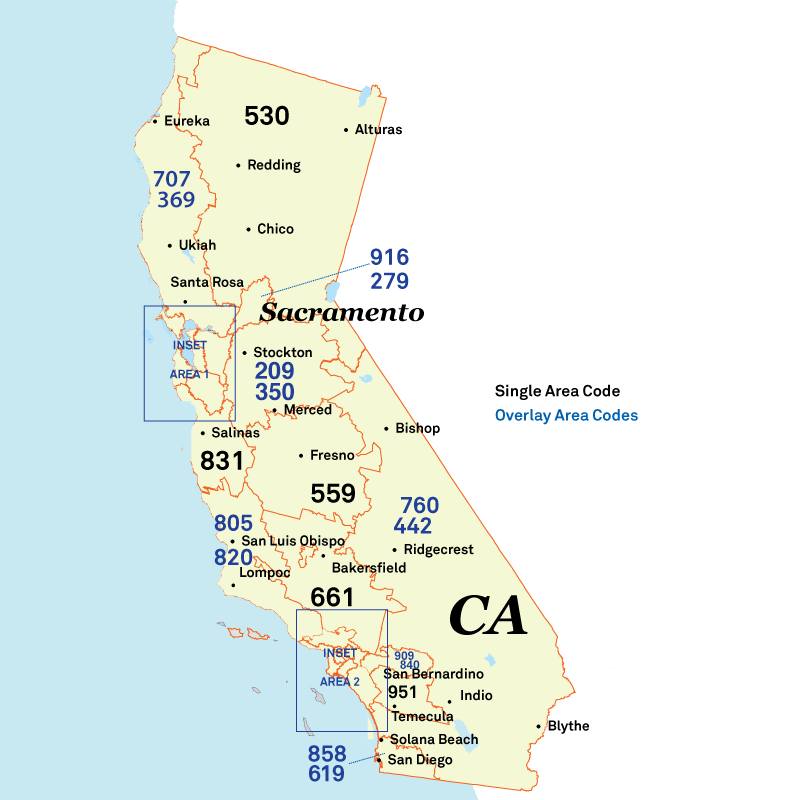
The 415 area code is serving San Francisco and its northern suburbs in Marin County, and the northeast corner of San Mateo County in California. Look up any phone number starting with 415 area code. Results may include:
The 415 area code is known for arrest warrant threats and fake health insurance calls. Callers claim your identity was used in a crime to get you to verify your personal details.
Robocallers claiming to be from the Social Security Administration threaten you with "legal enforcement action" and arrest due to "fraudulent activities" on your Social Security Number, warning that "deliberate ignorance of this message will be considered an intentional attempt of none appearance." They threaten to suspend your SSN or driver's license and warn of immediate "legal proceedings" or arrest by "federal officers." The caller identifies themselves with fake names and badge numbers like "Luke Harrison Badge # 66532." When you call back, they try to get your personal information or demand money to stop the fake arrest. The Social Security Administration never calls to threaten arrest. Real federal agencies send official mail first.
"This message is to inform you that there is a legal enforcement action has been filed on your social security number for fraudulent activities so when you get this message, speak to our office phone or timely call us back on our hotline number...don't disregard this notice and return the call before we begin with the legal proceedings against you..."
Blue Shield "Important Message About Your Child" Scam
Automated callers claiming to be from Blue Shield leave messages with an "important message" about your child, often knowing and stating your child's full name. They tell you to call back a different number like 833-896-7455, create urgency by claiming "pertinent information" about your minor child, then ask you to confirm personal details like a birthdate over the phone. They use this information to steal your child's identity or access your insurance benefits. Report the call to Blue Shield's Privacy Department at 888-266-8080. Real insurance companies use official numbers on your card, not mystery callback numbers.
"I received the same type of call today and they knew my childs name. I am a Blue Shield subscriber so i called customer service and they directed me to their PRIVACY DEPT. Whether you are a BS subscriber or not, the fact they have our children's name means there was a significant data breach and these calls should be reported to Blue Shield and the FTC."
Fake Bank Security Alert Texts
Scammers send urgent texts pretending to be from "Chase-Bank" or "WELLS-FARGO," falsely claiming an "unusual sign-in" to your account from another state like Idaho. The messages include suspicious links like s.id, bit.ly, or dns-report.com and come from standard 10-digit phone numbers, not official bank short codes. They use this fake emergency to get you to click the link to "verify your info," which leads to a fake website that steals your username and password the moment you enter them. Banks never send texts with links asking for login credentials. They use secure messages inside their official apps.
"CHASE: We have detected an unusual sign-in to your account from Idaho (160.2.125.29). Report and verify your info at https://s.id/DTtdm if this is not done by you."
"Your Cash App is Compromised" Robocall
Robocallers warn that your Cash App account has been compromised due to "suspicious activities," often mispronouncing "data breach" as "data bridge." They instruct you not to use your account until you call their fake support number to have it unblocked, then pressure you to call immediately to regain access to your funds. When you call the unlisted number, they try to steal your account details, login information, and access codes. Cash App communicates through their official app and verified emails, not generic robocalls. They never direct you to unlisted phone numbers.
"Our server has detected some suspicious activities on your cash app account as a result we have blocked all access to your account to prevent data bridge. Please do not use cash app account until you speak with cash app support representative. Please refrain using any financial activity on your account. In order to speak with in cash app at representative right now press one or please call on 415-688-6201."
Chinese Consulate Robocall Scam
Automated robocalls leave voicemails entirely in Chinese, typically Mandarin, impersonating the Chinese Consulate in San Francisco. They fabricate stories that you have an urgent document to pick up or are implicated in a crime, often coming from spoofed 415 area code numbers. Their goal is to create fear and confusion so you'll call back and give them personal information or money. Government consulates do not use unsolicited robocalls for important documents or legal proceedings. This is a well-known international scam.
"Saying in Chinese that it's the consulate and there is an important document for me to pick up... Typically tel scam, shame on those $T%&."
"Final Notice" Auto Warranty Scam
Robocallers use phrases like "final notice" to create false urgency, claiming your vehicle's warranty is expiring. They don't know the specific make, model, or year of your vehicle and continue calling even after you ask to be removed from their list. These calls go to everyone, even people who don't own cars, as part of widespread efforts to sell overpriced service plans or steal financial information. They use whatever you give them to charge your credit card or open accounts in your name. These calls are illegal robocalls, not legitimate business. Real companies don't cold-call with fake deadlines.
"Got call from 415-687-1201 and they left a message about extending some car warranty and I don't have a car so the call is spam."
Recently Reported Area Code 415 Spam Calls
Area Code 415 phone numbers reported as unwanted calls to the FTC in the last 30 days.
(415) 376-0622
9 reports
·
(415) 376-0509
5 reports
·
(415) 390-9160
4 reports
·
(415) 848-8271
3 reports
·
(415) 202-5633
3 reports
·
(415) 236-9808
3 reports
·
(415) 855-3825
3 reports
·
(415) 754-9851
3 reports
·
(415) 200-2021
2 reports
·
(415) 861-2615
2 reports
·
Is area code 415 a scam?
No, area code 415 is a legitimate California area code serving San Francisco and surrounding communities. Its association with a major financial hub gives it a level of name recognition that makes it highly useful to fraudsters.
Why do I get spam calls from area code 415?
Mandarin-language Chinese Consulate robocalls targeting Chinese-American communities are heavily documented here. Blue Shield insurance impersonators citing children's names, fake SSA arrest warrants from "Luke Harrison," and Cash App compromise robocalls are also highly active.
Where Is Area Code 415 Located?
Area code 415 covers the city and county of San Francisco, Marin County, and the northeast corner of San Mateo County.
Counties Served:
Marin County
San Francisco
San Mateo County
Major Cities:
San Francisco
San Rafael
Novato
San Anselmo
Sausalito
Mill Valley
Daly City
Brisbane
Other Cities and Towns:
Bel Marin Keys
Belvedere
Black Point-Green Point
Bolinas
California Park
Corte Madera
Dogtown
Fairfax
Greenbrae
Ignacio
Inverness
Inverness Park
Kentfield
Lagunitas-Forest Knolls
Larkspur
Overlay System
Area code
628
was assigned in 2015 to form an overlay with area code 415 in the same geographic region. Ten-digit dialing is mandatory in the area, with prefix *1* from landlines.
Area Code 415 Location Map
Area code 415 is a general purpose code which was placed in service on January 1, 1947.
Prefixes by Rate Center
Rate Center
Number of Prefixes
SNFC CNTRL
472
SAN RAFAEL
63
SNFC MT-EV
61
SNFC JUNPR
53
NOVATO
21
SAUSALITO
17
MILLVALLEY
16
BELVEDERE
15
CORTEMADRA
13
IGNACIO
13
POINTREYES
8
STNSN-BLNS
8
NICASIO
6
INVERNESS
5
Other California Area Codes
Browse California area codes for phone number lookup: