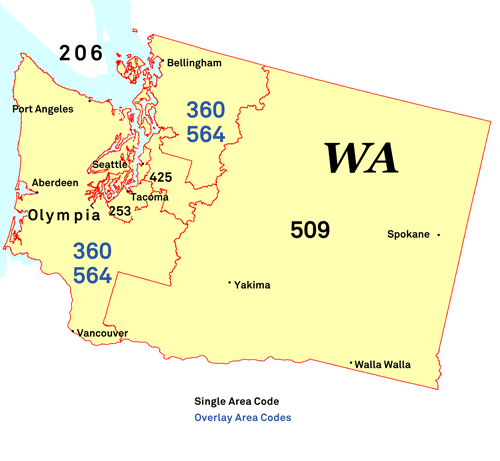
The 206 area code is serving Seattle and most of its innermost suburbs in the U.S. state of Washington. Look up any phone number starting with 206 area code. Results may include:
Seattle's 206 area code is being used for government lawsuit threats and Amazon purchase scams. Imposters try to convince you that you are in legal trouble or that someone hacked your account.
Callers pretending to be from the IRS or U.S. government claim a lawsuit has been filed against you for tax fraud and threaten arrest if you don't comply immediately. They use fake names like "Officer Ryan Smith," robotic voice messages threatening "arrest by the local cops," and claim they've tried contacting you for six months. They threaten to have your Social Security number "blacklisted" and provide fake case numbers like "c 982990" to sound legitimate. They use your compliance to steal personal information and money through fake payment demands. The IRS contacts people through official mail, not threatening phone calls. Real officers do not call first.
"Automated voicemail said there was a warrant for my arrest and that I must call them back."
Amazon Fraudulent Purchase Scam
Callers claiming to be from Amazon's fraud department report a suspicious, expensive purchase on your account like a "$1500.00 apple mac book" or "iPad Pro for an amount of $2160," often from Dayton, Ohio. Callers identify themselves as "Molly," "Mulligan," or "Sanjay Ahuja" and ask you to download remote access software or pay a "cancellation fee" with Target gift cards. They use the software to access your accounts and steal money, or they simply take the gift card numbers you provide. Amazon will never ask you to buy gift cards or install third-party software to resolve security issues.
"Pretending to be an Amazon employee and tricked me into sending him over $4000 money through Target Gift Cards."
Apple iCloud Breach Scam
High-volume robocalls warn that your "Apple iCloud has been breached" and instruct you not to use any Apple devices until you call their "support advisor" by pressing 1. People receive over 20 calls in just a few hours from different numbers with the same message. The callback number like 206-309-9231 is not a real Apple support line, and the call claims to be "toll free" but uses a Seattle area code. They use your panic to steal your Apple ID, password, and financial information through fake support calls. Apple does not make unsolicited calls about security breaches.
"That your iCloud account has been breached before using any Apple device. Please contact Apple support advisor, press one to connect with Apple support advisor... Please call us on our toll-free number 206-309-9231."
Social Security Administration (SSA) Scam
Callers claiming to be from the Social Security Administration say your Social Security Number has been "suspended" due to fraudulent activity or that a warrant is out for your arrest. They use names like "Chris Monroe" with badge number "CM-1912" or "Christine from National Disability" calling about benefits you never applied for. They claim "legal enforcement action" has been filed against your SSN and become aggressive or use profanity if you refuse to provide information. They use your SSN and personal details to steal your identity and open accounts. Your Social Security number cannot be suspended or canceled. The SSA communicates through official mail, never threatening phone calls.
"The caller stated he was calling from SS Admin in Washington D.C.. He gave his name as Chris Monroe badge # CM-1912... He advised me not to disconnect the call and if I did I would be red flagged as being uncooperative."
Fake Government Grant Scam
Callers with heavy accents inform you that you've been selected to receive a federal grant for a specific amount like "$9,000" or "$9,200." To claim this "free money," you must pay an upfront "registration" or "processing" fee around $200 via an eBay card or wire transfer at stores like Walmart or Walgreens. Callers may use names like "Evan Rogers." They steal your upfront payment and provide no grant money in return. The U.S. government does not call citizens to award unsolicited grants.
"They say there fedral grant givingbmomey they wanted me give bank info or prepaid card to send it to me...they wanted me to get prepaid card load 200 on it and give it to them to send me the money"
Fake Process Server & Legal Action Scam
Callers leave voicemails claiming you have been "officially notified" of a pending legal matter or complaint. They threaten to serve you at your home or workplace if you don't call back immediately, refuse to provide their company name or details about the supposed court case, and claim paying them over the phone will make the court case disappear. They steal money through fake payments and have no actual legal documents. Real process servers do not call ahead to warn you. They show up.
"Calls repeatedly claiming to be a process server many times in row. Claims they are sending someone to serve you at your work or home unless you pay them, but will not reveal their company name or anything about the supposed court case."
Publishers Clearing House (PCH) Scam
Scammers send text messages and make calls claiming to be from Publishers Clearing House, using names like "Juliet Smith," informing you that you've won large sums like "$250,000" and a new car. To claim your prize, they instruct you to buy gift cards or send money orders to an "agent" like "Kevin Martinez" to cover insurance and processing fees. They send real-looking checks for small amounts like $2,950 and ask you to send back a portion. They steal your upfront fees and the checks they send are fake and will bounce. The real Publishers Clearing House Prize Patrol shows up at your door with cameras and big checks. They never call or text ahead to demand payment.
"Husband got a call from 'Publishers Clearing House'. He won $950,000 and a car. He directed him to go to Walgreen's to get gift cards for insurance on the car."
Relentless Fax Machine Robocalls
Calls from rotating series of 206 numbers consist only of continuous fax machine beeping tones. These come repeatedly, sometimes dozens of times a day and even in the middle of the night, just minutes apart. Blocking one number doesn't help as they immediately call from a similar number. They tie up phone lines and fill voicemail with useless beeping recordings as they blast faxes to thousands of numbers hoping to hit working fax machines. This is junk fax marketing and they don't care about harassing businesses and residents.
"This number keeps trying to fax our business land line, despite numerous faxes back to them indicating they cease and desist, as it is not a fax, but a business land line."
Recently Reported Area Code 206 Spam Calls
Area Code 206 phone numbers reported as unwanted calls to the FTC in the last 30 days.
(206) 922-0880
8 reports
·
(206) 525-5540
8 reports
·
(206) 278-3209
6 reports
·
(206) 895-4895
5 reports
·
(206) 536-3696
4 reports
·
(206) 238-8192
4 reports
·
(206) 453-2329
3 reports
·
(206) 299-5360
3 reports
·
(206) 745-5159
3 reports
·
(206) 589-9391
3 reports
·
Is area code 206 a scam?
No, 206 is a legitimate area code covering Seattle and nearby communities like Shoreline and Burien. Because Seattle numbers carry the name recognition of a major tech hub, scammers spoof the prefix hoping recipients will assume the call is a legitimate business.
Why do I get spam calls from area code 206?
Callers impersonating Amazon's fraud department frequently report expensive fake purchases, then instruct victims to download remote access software or buy Target gift cards. Apple iCloud breach robocalls run the same playbook, alongside fake government grant calls offering $9,000 and fake Publishers Clearing House prize notifications.
Where Is Area Code 206 Located?
Area code 206 covers Seattle and its innermost suburbs. This includes suburbs such as Shoreline and Lake Forest Park; Mercer, Bainbridge, and Vashon Islands; and portions of metropolitan Seattle from Des Moines to Woodway.
Counties Served:
King County (implicit, as Eastside is mentioned)
Major Cities:
Seattle
Other Cities and Towns:
Bainbridge Island
Des Moines
Lake Forest Park
Mercer Island
Shoreline
Vashon Island
Woodway
Overlay System
Area code 206 will be converted to an overlay complex with area code
564
on June 10, 2025. Area code 564 also overlays
360
. Ten-digit dialing has been mandatory for all of Washington west of the Cascades since 2017.
Area Code 206 Location Map
Area code 206 is a general purpose code which was placed in service on January 1, 1947.
Prefixes by Rate Center
Rate Center
Number of Prefixes
SEATTLE
594
BAINBDG IS
18
DES MOINES
17
RICHMNDBCH
13
VASHON
5
Other Washington Area Codes
Browse Washington area codes for phone number lookup: